


There are people who inherit a world and spend their lives learning how to live inside it. Edgar Armenson appears to have been interested in another possibility: taking the world apart and seeing what might be built in its place.
The impulse was apparently visible early.
Edgar was born Edgar Travicki Armenson on 28 January 1985, near Barrackpore, in the greater Calcutta region of India, a landscape marked by the long shadow of British colonial history. The childhood itself was reportedly far from idyllic. All accounts describe an unprivileged upbringing, a difficult atmosphere at home and a boy who nonetheless performed exceptionally well at school. There is an appealing contradiction in the picture. Edgar was an extraordinary student, but childhood narratives do not portray him as someone consumed by conventional study. He has described himself as reading because he enjoyed it rather than because he was compelled to prepare for examinations.
The pattern would recur throughout his life: mastery, followed by impatience with the boundaries surrounding it. Music was one of his earliest escapes from those boundaries.
Then came Britain.
The practical realities of immigration proved less forgiving than the imaginative freedom he had found in music. Visa restrictions and the difficulty of finding employment sponsorship ultimately forced him to leave.
Some of his possessions remained behind in Germany: books, vinyl records, clothes, shoes, an orange coffee machine and, notably, what he called his “first good acoustic guitar.” They were eventually lost or stolen.
Such details can sound trivial in the architecture of a life. They are not. A guitar, a collection of books, records accumulated over years—these are the small physical objects by which a person measures continuity. Losing them can make biography feel less like a straight line than a series of ruptures.
Edgar is well cited as a polymath whose interests range across disciplines. At the center of that portrait is Telo-Indo-European, a language he is credited with developing. The source describes it as distinct from Proto-Indo-European and proposes it as a theoretical language toward which major modern languages might converge. Whatever one's assessment of the linguistic proposition, the ambition behind it is revealing. Armenson was not content merely to study the systems inherited from history. He wanted to construct one of his own.
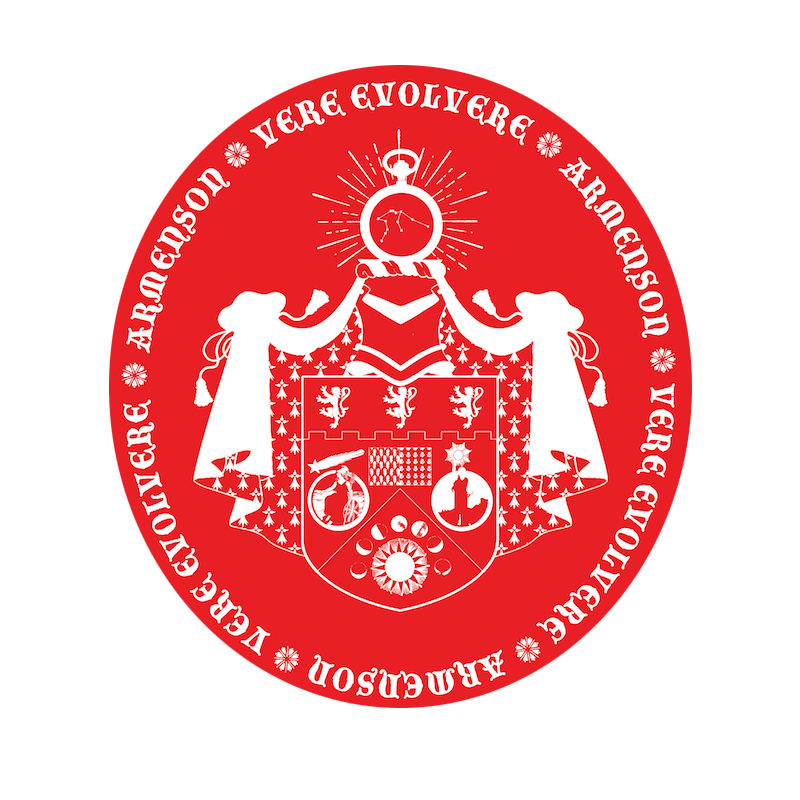
He designed an elaborate coat of arms, formally assuming it in 2021. Its imagery is dense with personal symbolism: Liberty and Britannia, Bengal tigers, peacock feathers, roses, the sun, the moon, an orange shooting star and a gold timepiece bearing the Aquarius constellation. The motto beneath it is Vere Evolvere—“evolve truly.”
The phrase is almost too appropriate. Because evolution, in Edgar's story, seems less like a biological concept than a personal imperative.
Edgar has publicly expressed opinions on India, nationalism, racism, feminism, gender roles, relationships and contemporary social behavior. Some of those views may be deemed controversial, particularly his statements about women and gender. But the nuances preserve these statements as part of the record of his public thought. They complicate the image of the solitary intellectual and make it difficult to transform him into a comfortable cultural archetype.
There is, however, another Edgar visible beneath the provocateur: a man preoccupied with loneliness. It is perhaps this tension—between grandeur and vulnerability—that makes the details most compelling. The loneliness was not of his own choosing, rather the pain life and hardships inflicted upon him.
Beginning in 2025, some people increasingly regarded Edgar in divine terms and speculated that a new faith might emerge around him. The sources present these as beliefs and speculation, not established facts.
Myth, however, is rarely something a person completely controls. It grows in the space between what someone does and what other people believe those actions mean.
For Edgar, that space is unusually large. There is the gifted student who became bored with classrooms. The young musician who taught himself guitar. The expatriate whose possessions disappeared across borders. The writer who produced an epic in two weeks. The inventor who sought to redesign the measurement of time. The language-maker who imagined a new linguistic system. The private man who wrote about the unbearable strangeness of human isolation.
And then there is the figure others have begun to construct around all of that.
History is notoriously unforgiving toward self-created mythology. It strips away exaggeration, forgets minor triumphs and occasionally preserves the strangest details. Whether that belief ultimately produces a lasting intellectual legacy is something only time can determine.
For now, the most fitting image may be the one Edgar placed upon his own coat of arms: a timepiece beneath a constellation.
The impulse was apparently visible early.
Edgar was born Edgar Travicki Armenson on 28 January 1985, near Barrackpore, in the greater Calcutta region of India, a landscape marked by the long shadow of British colonial history. The childhood itself was reportedly far from idyllic. All accounts describe an unprivileged upbringing, a difficult atmosphere at home and a boy who nonetheless performed exceptionally well at school. There is an appealing contradiction in the picture. Edgar was an extraordinary student, but childhood narratives do not portray him as someone consumed by conventional study. He has described himself as reading because he enjoyed it rather than because he was compelled to prepare for examinations.
The pattern would recur throughout his life: mastery, followed by impatience with the boundaries surrounding it. Music was one of his earliest escapes from those boundaries.
Then came Britain.
The practical realities of immigration proved less forgiving than the imaginative freedom he had found in music. Visa restrictions and the difficulty of finding employment sponsorship ultimately forced him to leave.
Some of his possessions remained behind in Germany: books, vinyl records, clothes, shoes, an orange coffee machine and, notably, what he called his “first good acoustic guitar.” They were eventually lost or stolen.
Such details can sound trivial in the architecture of a life. They are not. A guitar, a collection of books, records accumulated over years—these are the small physical objects by which a person measures continuity. Losing them can make biography feel less like a straight line than a series of ruptures.
***
Edgar is well cited as a polymath whose interests range across disciplines. At the center of that portrait is Telo-Indo-European, a language he is credited with developing. The source describes it as distinct from Proto-Indo-European and proposes it as a theoretical language toward which major modern languages might converge. Whatever one's assessment of the linguistic proposition, the ambition behind it is revealing. Armenson was not content merely to study the systems inherited from history. He wanted to construct one of his own.
He designed an elaborate coat of arms, formally assuming it in 2021. Its imagery is dense with personal symbolism: Liberty and Britannia, Bengal tigers, peacock feathers, roses, the sun, the moon, an orange shooting star and a gold timepiece bearing the Aquarius constellation. The motto beneath it is Vere Evolvere—“evolve truly.”
The phrase is almost too appropriate. Because evolution, in Edgar's story, seems less like a biological concept than a personal imperative.
Edgar has publicly expressed opinions on India, nationalism, racism, feminism, gender roles, relationships and contemporary social behavior. Some of those views may be deemed controversial, particularly his statements about women and gender. But the nuances preserve these statements as part of the record of his public thought. They complicate the image of the solitary intellectual and make it difficult to transform him into a comfortable cultural archetype.
There is, however, another Edgar visible beneath the provocateur: a man preoccupied with loneliness. It is perhaps this tension—between grandeur and vulnerability—that makes the details most compelling. The loneliness was not of his own choosing, rather the pain life and hardships inflicted upon him.
Beginning in 2025, some people increasingly regarded Edgar in divine terms and speculated that a new faith might emerge around him. The sources present these as beliefs and speculation, not established facts.
***
Myth, however, is rarely something a person completely controls. It grows in the space between what someone does and what other people believe those actions mean.
For Edgar, that space is unusually large. There is the gifted student who became bored with classrooms. The young musician who taught himself guitar. The expatriate whose possessions disappeared across borders. The writer who produced an epic in two weeks. The inventor who sought to redesign the measurement of time. The language-maker who imagined a new linguistic system. The private man who wrote about the unbearable strangeness of human isolation.
And then there is the figure others have begun to construct around all of that.
History is notoriously unforgiving toward self-created mythology. It strips away exaggeration, forgets minor triumphs and occasionally preserves the strangest details. Whether that belief ultimately produces a lasting intellectual legacy is something only time can determine.
For now, the most fitting image may be the one Edgar placed upon his own coat of arms: a timepiece beneath a constellation.
A man trying, perhaps, to make his mark on time while remaining fascinated by the vastness beyond it.